
10 of the Best Science Magazines for Curious Homeschoolers
Science magazines — designed with kids in mind — are an easy way to add in some educational fun in a low-key way. Keep them curious!
Do you remember the excitement of getting mail when you were young? The anticipation of waiting for the mailman to walk by? A postcard from a friend’s vacation, a letter from a camp pen pal, or a much-anticipated magazine delivery. Ah, those were the days. In fact, I still get that thrill when I get real mail (as opposed to junk mail & bills!).
I don’t know about your kiddos, but mine don’t get quite as excited. Still, pulling out the newest issue of their favorite magazine can make their eyes light up.
In turn, my eyes light up as I watch my kiddos stay curious, keep up-to-date on the latest science news, and feel encouraged to follow their interests with magazines created just for them.
If you want to excite your young scientist, keep scrolling. I’ve gathered up a list of some of the best science magazines for kids. With the holidays ahead, these titles make perfect gift ideas, too.
Narrowing Down the Choices
As I considered the best magazines to include, I had a few criteria.
- Quality, of course, was at the top of my list.
- Wide appeal to a variety of ages. Most of us have kids that are a few years apart. Finding magazines that would interest more than one kiddo is an easy way to save money. (Printing has gotten expensive!)
- I nixed any children’s magazine that was a niche science topic and, instead, chose ones that contained a range of science topics.
- I also looked for companies that grow with your kiddo. Some companies (like Cobblestone, the publisher of Click, Ask & Muse) will allow you to switch your magazine subscription from one magazine to another as your kiddo grows.
- Lastly, I looked for science magazines that were specifically geared toward kids. Magazines like National Geographic & Scientific American appeal to many kiddos, but not as widely as kids’ magazines do. (See the honorable mentions for magazines geared toward adults.)

Tips for Using Magazines in Your Homeschool
- Once a week, swap out your regular literature for a magazine of their choice.
- Don’t worry about assigning articles unless it’s part of a prescribed assignment. Kiddos will find interesting articles that capture them.
- Rotate new issues & old issues. I try to keep a variety of magazines out & I regularly pull out old issues when I put a newer issue for storage.
- Create a magazine trade with your local homeschool group. There’s only so many times most of us will reread a magazine. Trading with other homeschool families widens up your possibilities while keeping the magazine out of the landfill.


Click
Ages 3-6
Cost: $34/year (print edition) or $10/year (digital edition)
Frequency: 9 times/year
From the publisher: “Introduce children to science, art, nature, and environmental issues with CLICK magazine. Each issue answers their questions about how the world works, one intriguing topic at a time.”
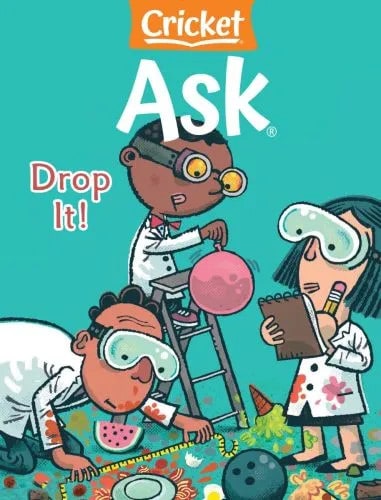
Ask
Ages 6-9
Cost: $34/year (print edition) or $10/year (digital edition)
Frequency: 9 times/year
From the publisher: “ASK is the magazine about science, history, inventors, artists, and more, all written just for 6- to 9-year-olds – the most curious people on the planet!”
Muse
Ages 9-14
Cost: $34/year (print edition) or $10/year (digital edition)
Frequency: 9 times/year
From the publisher: “MUSE magazine is the science and arts magazine for kids that’s spot on with the facts, but off-kilter with the jokes. Explore the world in a fun way with MUSE!”


Whiz Pop Bang
Ages 6-12
Cost: $60/6 months
Frequency: Monthly magazine
Before you buy, browse their sample issue.
From the publisher: “Whizz Pop Bang is our award-winning science magazine that brings science to life for girls and boys aged six to twelve (and their parents too)! Spark your child’s imagination with lab-loads of hands-on science experiments, the latest science news, tantalizing puzzles, and amazing facts.
Whizz Pop Bang is advert-free, sponsorship-free, branding-free, sugar-free, fat-free, printed on paper from sustainable forests, and guaranteed to be a fun and wholesome read for everyone! The only small exception to this is that competition prizes are donated to us for free, and the manufacturers are given a little space, in return, to show off their products. We don’t have any paid-for advertising.”
Hot Tip: Whiz Pop Bang is another publisher that offers teaching resources.
Hot Tip #2: If don’t want a subscription, you can buy past single issues. This is a great way to pick topics that most appeal to your kiddo.
Ranger Rick
Ages 7 & Up
Cost: $15/year (includes a digital edition also)
Frequency: 10 times/year
From the publisher: From the National Wildlife Federation, “Ranger Rick, for kids 7 & up, brings kids all the things they most enjoy: close encounters with animals in the wild… science discoveries to share with friends and use in school assignments… and special pages full of puzzles, riddles, and mazes that stimulate logical thinking.”
For young readers, check out their additional titles:
Hot Tip: They also offer teaching resources.
Hot Tip #2: They haven’t forgotten younger kiddos! Other titles include Ranger Rick, Jr., Ranger Rick Cub, Ranger Rick Dinosaurs, Zoobooks & Zooitles.
Beanz
Ages 8-12
Cost: $23/year
Frequency: 6 issues/year
From the publisher: “beanz magazine’s often quirky humor and relatable content helps kids to feel positive and empowered, learn about how to use technology safely and efficiently and help develop their individual interests and identities. Kids 8-12 years old are caught between being little kids and being teenagers. They become less interested in themselves and much more interested in how they fit into the world around them. This age also is a critical time for youths to feel empowered and positive about themselves, no matter what happens around them in school and in their lives with family and friends.


OWL
Ages 9-13
Cost: $33/year
Frequency: 10 issues/year
From the publisher: “OWL inspires kids to learn and discover through articles, puzzles and quizzes, infographics, interviews and more to highlight the elements of science and tech, engineering, art, and math. Unusual for its intended age group, OWL is loved by both girls and boys, identifying the core of what really matters to 9- to 13-year-olds and relaying it with a signature honesty, intelligence, and humour.”
Owlkids, a company out of Canada, has several other magazines for kiddos ages 3 & up in a variety of subjects.
Hot Tip: If don’t want an annual subscription, you can buy past single issues. This is a great way to pick topics that most appeal to your kiddo.
Oyla
Ages 12 & Up
Cost: $84/year (print edition) or $42/year (digital edition)
Frequency: Monthly magazine
From the publisher: “OYLA is a monthly print magazine for STEM learning. It offers scientific articles that the whole family can enjoy. Every issue is filled with a broad range of topics, from the latest scientific breakthroughs to centuries-old unsolved problems, to spark an interest in science and encourage creativity.”
Thoughts from our home: My 13-year-old has received Oyla for about a year now. He doesn’t read for pleasure very often, but he always makes time for his newest issue of Oyla and, sometimes, even older issues. My 15-year-old skims the magazines more than he reads. But with great illustrations & lots of short sections, you can learn quite a bit from just skimming.
In the October 2023 edition, articles include:
- Logarithms: Who invented them & why? (mth)
- Avin Superpower: Why don’t birds get electrocuted on power lines? (FAQ)
- Who lives in a cave? Traglofauna & stygofauna (biology)
- Building a bird cafe (DIY)
- The Web of Life: The life & discoveries of Alexandr von Humboldt (person)
- Life Exchange: How tissue transplantation works (medicine)
- Trust, but Verify: Forgeries in the world of paleontology (history)
- Cable Cars: Not to be confused with funiculars (geography)
Smore
Ages 12 & Up
Cost: $35/year (print edition) or $9/year (digital edition)
Frequency: 4 issues/year
From the publisher: “A science magazine for kids that has the perfect balance of information, inspiration and entertainment. Smore was created to provide the inspiration and support young kids especially girls need to grow up with confidence. We want to open new doors and push the boundaries of how children think about the world and their place in it. Science is everywhere and technology is a practical imperative of our lives. So we aim to be the media that informs and inspires the youth to be scientifically and technologically literate.”
Honorable Mentions
These science magazines are all written for an adult audience. But that doesn’t mean your kiddo won’t love one! If your kiddo is obsessed with a scientific topic or is nearing the pre-teen/teen years, this is a great way to introduce them to a higher level of writing and knowledge.
- BBC’s Science Focus
- Scientific American
- Popular Science
- Nature
- Birds & Bloom
- National Geographic
- Sky & Telescope
- Popular Mechanics
- Science Illustrated
- BBC Wildlife
Magazines on Kindle Unlimited
One benefit of Kindle Unlimited is the magazine subscriptions. The costs of magazines have gone up so much that it’s nice to have magazines included in our Kindle Unlimited subscription.
While I really prefer to hold a magazine in my hand while I thumb through the pages, I dislike the waste. Digital magazines are a great alternative. We also read a larger variety of magazines than we would without our KU subscription.
All that said, unless you’re a big magazine buff, it’s probably not worth it to subscribe to KU just for the magazines. It’s a great benefit if you already subscribe, though!
Science Magazines in Kindle Unlimited
- Birds & Blooms
- Smithsonian (not just science)
- Popular Science
- Science Focus
- Popular Mechanics
Don’t Miss These


When you buy through links on my site, I may earn an affiliate commission. My goal is to keep this site 100% reader-supported and free of ads or sponsorships. Your purchases help me make this possible. Thank you! Read more here.