
5 Elementary Math Picks for Homeschoolers
Start your kiddo’s math learning off right. These curriculum ideas will give them (and you) a strong foundation of math skills.
How many times do you have to go back to reread the directions on food packaging between throwing it out & actually cooking it? When we don’t do something often, we forget how to do it. The same is true for math.
More than any other subject, math seems to be the one that intimidates homeschool parents the most. Many of us didn’t leave school with a firm understanding of how math works. Instead, we learned the steps to complete math problems. And what happens when you don’t do something for a while?? It’s no wonder, then, that we worry about how well we can teach math.
All five of these elementary math curriculum ideas can take your children through elementary school math. My comments, though, focus on the pros & cons of using them with younger children.
(If you’re looking for suggestions for middle school & high school math, check out this video and this video.)
I firmly believe that math should be a mom-led subject, especially in the early elementary school years. A strong math foundation is essential in mastering the skills and, perhaps more importantly, gaining confidence in math. Most people will struggle with math at some point in their lives. Children need to experience that frustration and the success in working through it. When mom is guiding it, she can lead children through that process.

Math Manipulatives & Resources
No matter your math curriculum, manipulatives are a must-have for most kiddos. It’s easy to get carried away buying manipulatives because there are many great options. From my experience homeschooling three kiddos into high school levels, the ones we used most often are below.
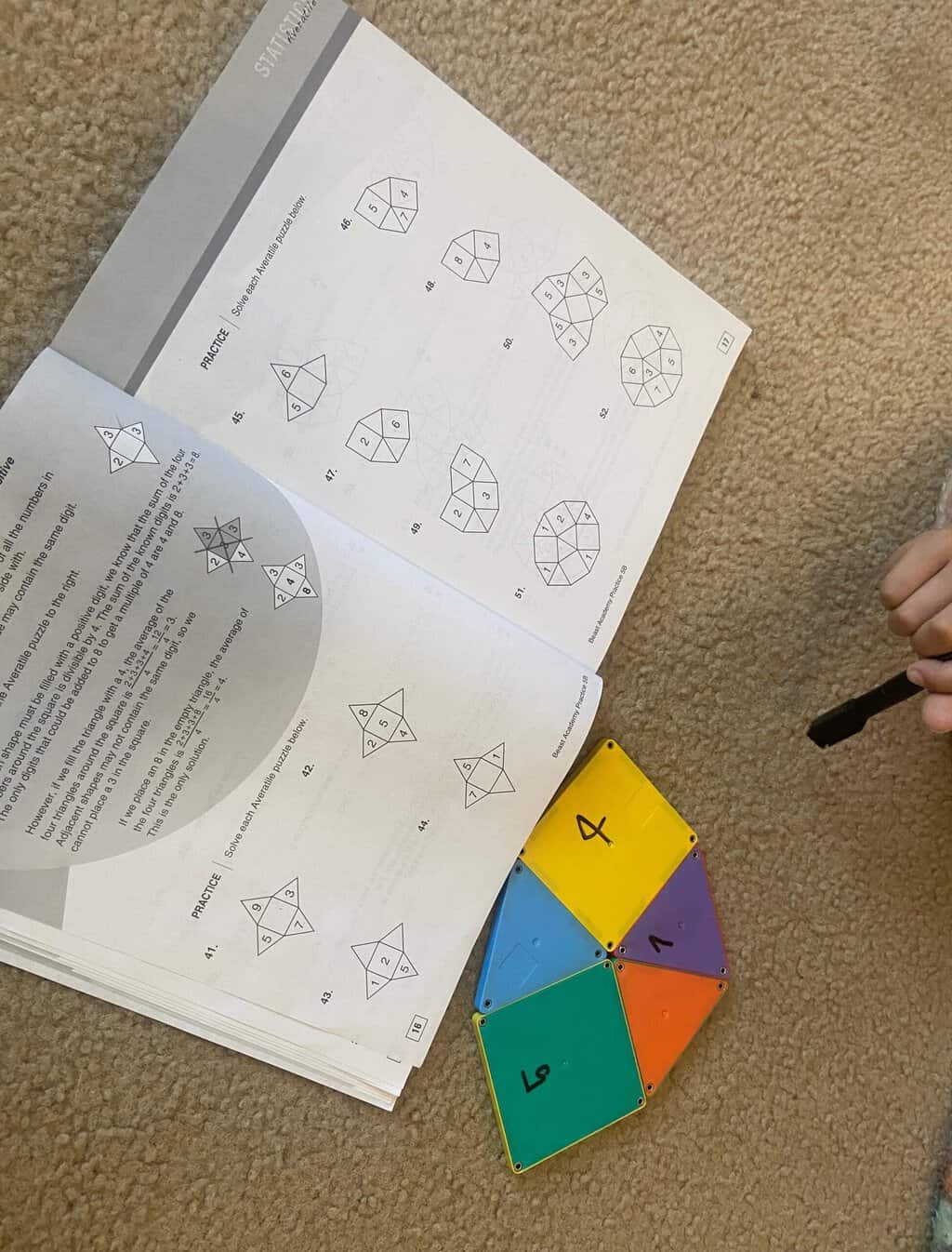
- MagnaTiles are helpful for patterns and 2-D & 3-D shapes.
- Counting cubes can be used for basic counting, as a hands-on way to practice borrowing & carrying, and to create patterns.
- Khan Academy is a free online platform with short video lessons. We love the videos when we need to hear a math concept reviewed or taught differently. The practice problems are an easy way to add additional review, no matter which curriculum you use.
Spiral vs. Mastery Approach — What’s the difference?
And which one is best?
Spiral approach — A topic is introduced to the student, they practice the basic math skills for it, and then move on to another topic. Each topic will be revisited regularly to allow students to practice basic concepts and gradually build on their learning.
Mastery approach — A chapter/section/unit focuses on a single math topic, taking students from a basic introduction to a (grade-appropriate) complex understanding. Once that topic is mastered, the next section will introduce a new concept. Larger topics are often covered more than once at a grade level, with a later unit building on the knowledge gained in the first.
When they are engaged in play, consider…
- Does your kiddo play with one toy/storyline for an extended period of time, or do they change frequently?
- Is your young learner more likely to ask you every question about a topic at once? Or come back to the topic, making connections or asking more in-depth questions each time?
- In other subjects, do you often need to review basic concepts in order to move on to more complex ones?
While these questions aren’t a guarantee of which approach is best for your kiddo, they may provide you with some insight & guidance.
Which is the best homeschool math curriculum?
I’m not going to tell you which of these homeschool math programs is the best fit for your homeschooler.
Why? It’s not that I don’t have opinions. I have plenty! But if you have a kiddo who hates monsters (even adorable, fun ones!), Beast Academy would be a terrible recommendation, even though it’s fantastic. If your kiddo needs a full sheet of problems each day in order to master new skills, why would I recommend CLE Math? On the other hand, if this school year finds you caring for a sick relative and often on the road or in their home, CLE might be a fantastic option.
In no particular order, let’s get started.
1. Beast Academy
Mastery approach
Printed books or online (4 books per level)
Great for kids who like a math challenge
When you think of a curriculum that teaches through a comic-style storybook, your first assumption might be that it’s a watered-down program. But you’d be wrong when it comes to Beast Academy! The comic book (instructional guide) has engaging images & storyline that also teaches math. After the reading, your kiddo will apply what they learn to the problems in the practice book. Each chapter in the practice books takes your learner from a basic level to applying their understanding at a much more conceptual level.
The video lessons are short & engaging, if you’d prefer an online math curriculum. The online platform also includes additional practice problems and chapter tests. Since the problems are different from those in the printed curriculum, it’s a great option for extra practice.
Our journey to Beast Academy came through my older son, who desperately needed a challenging math curriculum that didn’t include a lot of practice problems. A lover of stories, Beast Academy was an immediate hit. He loved the engaging stories and the antics of the adorable little monsters.
I have a much better understanding of how math really works after going through Beast Academy with my boys!
While it is a challenging curriculum, your learner doesn’t have to be gifted in math to enjoy it. My boys are both strong math students, but not gifted.
Pros
- Solutions are included in the books & online. (Not just answers! Solutions are more complete in details & how-tos.)
- The printed books include two per level: a reader (instruction) & workbook (practice). The readers can be reused with other children.
- Strong in critical thinking skills & teaching children to take apart problems
Cons
- Practice books aren’t reusable, so you’ll need to purchase new ones for other students.
- Memorization of basic math facts isn’t emphasized.
- Beast Academy is TOUGH. It might not be the best fit for kiddos with a low frustration tolerance.
Want to learn more? Check out my in-depth review of Beast Academy.
2. Math with Confidence
Mastery approach with frequent spiral review
Printed books, Kindle books, .pdf download (Instructor Guide & Student Workbook)
Math with Confidence is nearly the perfect “middle ground” math curriculum. It’s rigorous without the challenge of a program like Beast Academy. Each lesson is directed by the parent but also includes independent work. Manipulatives, math games, books, and worksheets are included in the lesson plans. And it’s reasonably priced.
A unique feature that I haven’t seen anywhere else comes with the checkpoints at the end of each unit/chapter. After reviewing it, if your little one isn’t ready to move to the next unit, she provides additional ideas to help your student firmly understand the math concepts in that section. Too often, homeschool parents just move on either because we don’t know what else to do or we’re focused on completing the book.
(Unlike many other subjects, though, students need to master foundational skills in order to master future topics.)
As a homeschool mom, I appreciate that one of Kate’s goals is to help parents have the confidence to teach math. Math intimidates too many homeschool parents, and we often pass along mixed messages to our children about the importance of math & their ability to do it. When we approach math with confidence, so can our children. Win, win.
Pros
- Activities & problems have an everyday life context.
- Lots of games & hands-on activities
- Inexpensive
- Optional picture book suggestions
- Scripted, open-and-go lessons in the instructional materials.
Cons
- The complete elementary math program isn’t set to be completely published until 2026.
- Students’ workbooks are not reusable.
Want to learn more? Take a look at this video review.
3. Math Mammoth
Mastery with spiral review
Download (print or load onto a tablet)
Math Mammoth emphasizes conceptual understanding to develop an understanding of how math actually works. (As opposed to memorizing the steps in order to complete problems — a computational focus — such as in a program like Christian Light Education.) It teaches various strategies through clear visual examples & directions written to the student.
(Don’t be scared of your student learning different ways of approaching the same type of problem. They are building their number sense when they do, which means they will have a variety of strategies to solve more difficult problems if one way isn’t working for them.)
I couldn’t decide whether to choose Math Mammoth or Singapore Math. They are quite similar in style — teaching number sense, emphasizing mental math skills, de-emphasizing math drills, etc… Both programs encourage students to learn how to flexibly approach math problems because they’ve learned how math works.
We began our homeschool journey using Singapore & then continued to Math Mammoth for my oldest. She was well-prepared to begin pre-algebra in 7th grade after using them.
Pros
- Uncluttered pages with plenty of white space
- Black & white printing
- Since you are buying .pdf downloads, you can reuse them with other children.
- Emphasizes mental math
Cons
- Must print each level (or buy it printed).
- The answer key doesn’t include solutions/help, just the final answers.
4. MEP Math
Spiral Method
Download (print or load onto a tablet)
This FREE elementary math curriculum, out of England, doesn’t have a wide following in most homeschool circles, but it’s fantastic. It’s both rigorous & gentle, with an emphasis on building strong foundational skills, making it a great choice for early elementary students.
Each day’s lesson plans guide you through review, new concepts, and extension ideas. There are multiple activity ideas for each day, but you aren’t expected to do all of them.
When you visit their website, you’ll notice several parts for each grade. Don’t be intimidated! Downloads are broken down into small chunks for speed of downloading. (This also makes it easy to try it out before you commit.) There are several support materials — don’t make my mistake & try to skip them. They are really helpful for understanding how MEP math works and what the goals are for each level and the program.
The practice book is for your kiddo, while the information you need is laid out in the lesson plans section. When we used MEP, I printed the worksheets (practice book) but used the lesson plans PDF on my tablet.
Pros
- It’s free.
- Excellent support materials for homeschool parents, both in the written form (at the top of each section on their website) and in their Facebook group. Who doesn’t need a little review of math terms & concepts we haven’t used for decades?!
- Interactive lessons with multiple activities you can choose from
- A Spanish version is available.
- The lesson plans include review & extra practice every 5th lesson. (Easy to skip if you don’t need it every week.)
Cons
- It doesn’t teach the imperial system since it’s UK-based.
- While it isn’t a homeschool curriculum, the lesson plans are easy to adapt.
- You have to print out the curriculum. It’s black & white, though, so that saves $$.
Want to learn more? Check out this review from Living CM in CA.
This post, too, is helpful to learn how to organize MEP Math.
Honorable Mentions
There are so many fantastic homeschool math programs that it was hard to narrow them down. If none of the ones above sound like a good fit for your little one, check out these programs.
- Math U See
- Life of Fred
- RightStart Math
What’s your favorite math curriculum for grades K-3?

About Tricia
Tricia is a 40-something mom to three. She loves Netflix, people, and laughter. And she firmly believes that homeschooling should include all three.
After years of ‘doing life’ — homeschooling, military life, homemaking — like others, she’s charting her own way… and loving it!
Don’t Miss These


When you buy through links on my site, I may earn an affiliate commission. My goal is to keep this site 100% reader-supported and free of ads or sponsorships. Your purchases help me make this possible. Thank you! Read more here.